Public code is not open source
A GitHub repository you can read is not automatically a repository you can reuse. Without a licence, copyright law means all rights are reserved. The author has not given you permission to copy or redistribute the code. Being able to read code and being allowed to redistribute it are two different things. Mixing them up can lead to a directory hosting files it has no permission to host. This is one of the strictest rules in extdir, and it affects a lot of the code.
What the corpus actually declares
Of 423 indexed Shopware extensions:
| Licence status | Count |
|---|---|
| Permissive (MIT, Apache, BSD) | 321 |
| Copyleft (GPL, MPL, EUPL, OSL) | 35 |
| Not an accepted open source licence | 64 |
| Nothing detectable | 3 |
| MIT alone accounts for 308 packages. | |
| The interesting number is 64. That is about one in seven extensions. Most of them contain the same declaration: |
{
  "license": "proprietary"
}
The proprietary default
composer init writes "license": "proprietary" when the licence prompt is left unanswered.
A lot of packages have kept that value in their metadata even though the repository later got an MIT LICENSE file. The author added the file but never updated composer.json.
So can we trust the declaration?
It is still the maintainer's own statement, so it is useful evidence. But a default value that nobody changed is a weak signal. Treating it as the final answer would incorrectly classify many packages that are actually open source.
The solution is to check both sources and record which one was used.
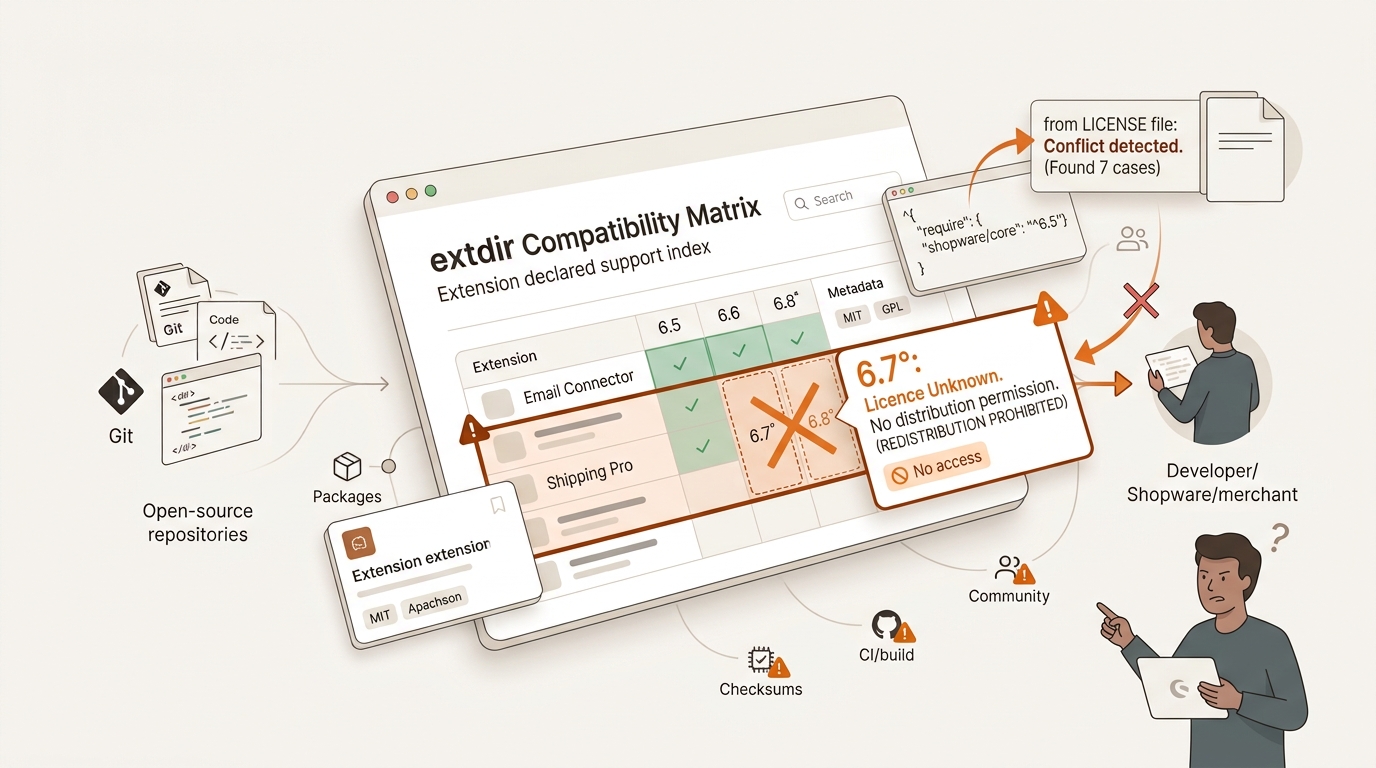
We detect licences from repository files and from the package metadata. If they disagree, the entry shows a visible from LICENSE file marker.
This happened 7 times in the current corpus. Seven packages had one licence in composer.json and another in the repository.
Seven is not a lot, but those seven packages would have been classified incorrectly without checking the repository. The marker also makes the conflict visible instead of hiding it behind an automatic decision.
Never infer from a README
A README saying "MIT licensed" is not a licence grant.
Neither is a badge image or a sentence on a marketing page.
For the licence check, we only use the licence file in the repository and the declaration in the package metadata. The detector checks the actual file contents instead of searching for licence names in normal text.
This matters because "MIT licensed" in a README without a LICENSE file is common. Usually it means the author intended to use MIT but never added the actual licence file.
Intent is not the same as permission.
So the entry says the licence is unknown, because that is what we can actually prove. The maintainer can fix it by adding the licence file.
Copyleft is never softened
There was an early bug here that is worth mentioning because it was silent. Licence results can come from multiple sources. The original reconciliation logic allowed a later permissive result to overwrite an earlier copyleft result. That caused three AGPL packages to be reported as MIT. Nothing in the interface made this obvious. A merchant could have installed an AGPL extension into a hosted shop while believing it had no copyleft obligations. That is exactly the kind of mistake licence metadata should prevent. The rule is now simple: every licence finding is considered, and copyleft always wins over permissive licences. If any source says GPL, the result is GPL. A false permissive result creates a compliance problem for whoever relies on it. A false copyleft result is the conservative choice and does not grant anyone extra rights. This matters in the Shopware ecosystem. GPL and AGPL extensions do exist here, many inherited from Shopware 5. Showing all of them under a general "open source" badge would be misleading for operators of hosted shops.
What the rule means for the platform
The licence rule directly controls what the platform is allowed to do:
- Unlicensed repositories are indexed and linked, but never mirrored, rebuilt, or packaged. The entry shows that the licence is unknown and that redistribution is not allowed.
- Every artefact that gets built must include the original
LICENSEfile. MIT, BSD, and Apache require the licence notice and text to remain in redistributed copies. A ZIP without the licence file can therefore violate the licence. - The Composer repository excludes unlicensed packages completely. Providing a
distURL is distribution, so we cannot do that for packages without a usable licence. The same rule applies to extdir's own dependencies. This is why the self-hosted fonts on the site include their OFL licence text as well. If we require licence hygiene from everything we index, our own dependencies have to follow the same rules.
The uncomfortable part
Being strict reduces coverage. Sixty-four extensions show a warning instead of a normal licence badge. Their maintainers may think this is unfair, especially when the code has been public for years. The alternative is worse. A directory that guesses in favour of the maintainer will eventually tell someone they can redistribute code when they actually cannot. The person relying on that information takes the risk, not the directory that made the guess. The full rules and the code that enforces them are public: extdir.com, source on GitHub.
Author Amer Malik Mohammed
Full-Stack Developer with 2+ years of experience in object-oriented PHP development (Symfony), JavaScript and MySQL. Specialized in e-commerce solutions (Shopware 5/6), REST API development and process automation in agile teams.
Contact author