The question nobody can answer
Ask a Shopware agency whether an extension works with 6.7 and you will usually get a guess, a shrug, or an afternoon of reading GitHub tags.
There is no index that answers this question. The Shopware Store does it for commercial extensions, but a large part of the open source ecosystem has nowhere to check. The agency plugin published to Packagist, the shipping module someone wrote in 2019, and everything in between are mostly on their own.
That is why extdir exists. Building the answer turned out to be more interesting than expected.
The data is already there
Every Shopware extension is a Composer package, and every Composer package declares what it requires:
{
  "require": {
    "shopware/core": "~6.5.0"
  }
}
That constraint is the answer, and it is machine readable.
Packagist publishes it for every version of every package, for free and without authentication. The difficult part is not getting the data. It is being clear about what the data actually tells us.
Declared, not tested
A constraint is a claim from the maintainer, not a test result.
Nobody at extdir has installed every extension in a Shopware 6.7 shop and tested the checkout. That is why the interface says declares instead of works with.
The wording matters. An index can report what a package declares. It cannot turn that declaration into a warranty.
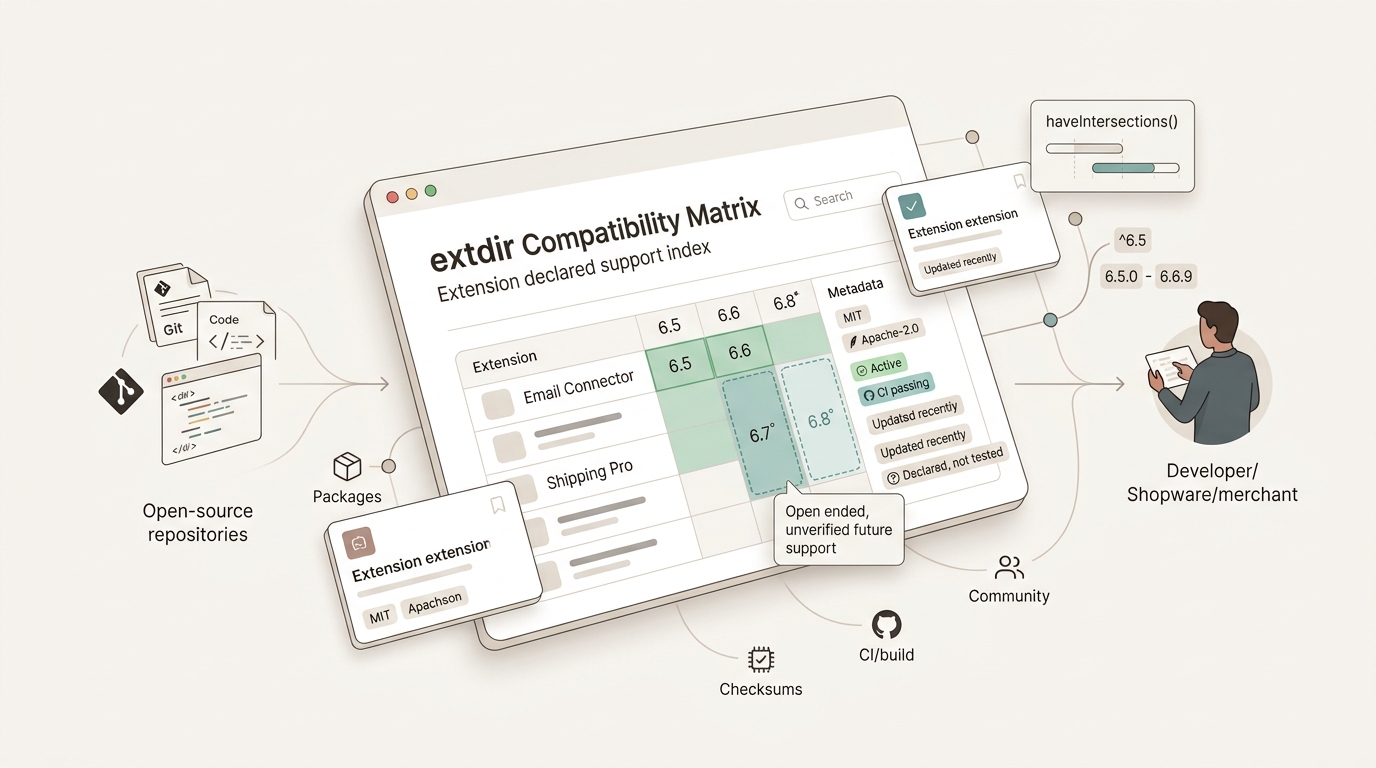
We parse the constraints with composer/semver, the same library Composer uses. For every release and every Shopware minor version, we check whether the declared constraint overlaps with the version range:
Intervals::haveIntersections(
    $this->parser->parseConstraints($declared),
    $this->rangeFor($shopwareVersion),
);
Using the actual library instead of a regex matters because Composer constraints have edge cases.
For example, ~6.6 and ~6.6.0 look almost the same but mean different things. The first allows 6.x versions starting from 6.6. The second stops before 6.7.
A regex that treats them as the same is wrong. You might not notice until an extension breaks on a real shop.
The honest part: open ended constraints
This is the problem that shaped the interface:
"shopware/core": "^6.5"
This declares support for 6.5, 6.6, 6.7 and future 6.x releases, including versions that may be released years after the extension was last updated.
Technically, those future versions satisfy the constraint.
Practically, that does not mean the maintainer tested them. The maintainer made a declaration about software that did not exist yet.
Showing that as a simple green check would give users more confidence than the data supports.
So constraints are split into two groups:
- Explicit: a bounded range that identifies the version. The maintainer made a specific declaration.
- Open ended: a caret or wildcard that reaches into future versions. The constraint is satisfied, but the support cannot be verified.
Open ended cells use a dashed border and a ˚ in the label.
There are two signals instead of relying only on colour. That keeps the distinction visible in greyscale, for people with colour vision issues, and on poor displays. Using colour alone would also fail WCAG 1.4.1.
What the corpus actually looks like
Measuring the data before designing the UI avoided a bad interface.
Of 423 indexed extensions:
- 204 declare support for only one or two Shopware versions
- 40 declare no versions that can be parsed
- 40 declare eight versions, which is usually a wildcard rather than eight specific compatibility claims
The first version of the matrix had five fixed columns with dots. A dot could be filled, half filled, or empty.
With this data, about two thirds of the cells were empty. To understand what each dot meant, you had to look back at the column header.
It looked like a data table but was difficult to read.
The fix was to stop displaying absence.
Cells now contain the version itself, for example 6.6 or 6.7˚. Unsupported versions are not shown at all.
If a chip already says what version it represents, there is no need for another header or legend.
What it cannot tell you
The matrix is based on package declarations, so its limitations come from those declarations.
An extension can declare 6.7 and still be broken.
It can omit 6.7 and still work.
A composer.json that was not updated after a rushed release can be wrong in either direction.
What the matrix does provide is a quick way to turn an afternoon of GitHub tag research into a glance. It also makes the uncertain cases visible instead of presenting them as confirmed support.
That is a smaller promise than "this works", and it is the only promise the available data supports.
The compatibility data, ranking formula, and platform itself are public: extdir.com, source on GitHub.
Author Amer Malik Mohammed
Full-Stack Developer with 2+ years of experience in object-oriented PHP development (Symfony), JavaScript and MySQL. Specialized in e-commerce solutions (Shopware 5/6), REST API development and process automation in agile teams.
Contact author